Think With Me - Rhythm & Meter
This is the first of many “think with me” pieces. The basic idea is, well…to think with me!
I’d like to spend some time considering rhythm and meter because as a cellist growing up in the orchestra, we didn’t get a lot of exposure to rhythmically interesting pieces (more or less). So in this first “think with me” post, let’s work our way through ideas of rhythm and meter. We’ll do so by looking at a few different pieces of music by very different composers and teachers in addition to a few texts by historians and theorists. And—given the title of the series—you can expect this to not necessarily follow a “beginning-to-end” sort of process. Rather, we’ll jump around ideas, topics, definitions, etc. as we get more comfortable with the topics at hand. So, let’s get started!
Schubert, Moments musicaux, D. 780, no. 6 (A-flat)
This short piece is deceptively difficult to play and to analyze. At first glance, it has all the characteristics of a romantic piano piece: somewhat chromatic harmony, enharmonic respellings, counterpoint in the “innards” of chords, and occasional flashes of pianistic brilliance (by this I mean there are only a few moments for the pianist to truly “show off,” though that’s not to say the piece is easy by any stretch). Often composers will give hints of what they’re up to in the first few measures of their pieces (Mendelssohn especially loved to do this). Let’s see what we get with Schubert:
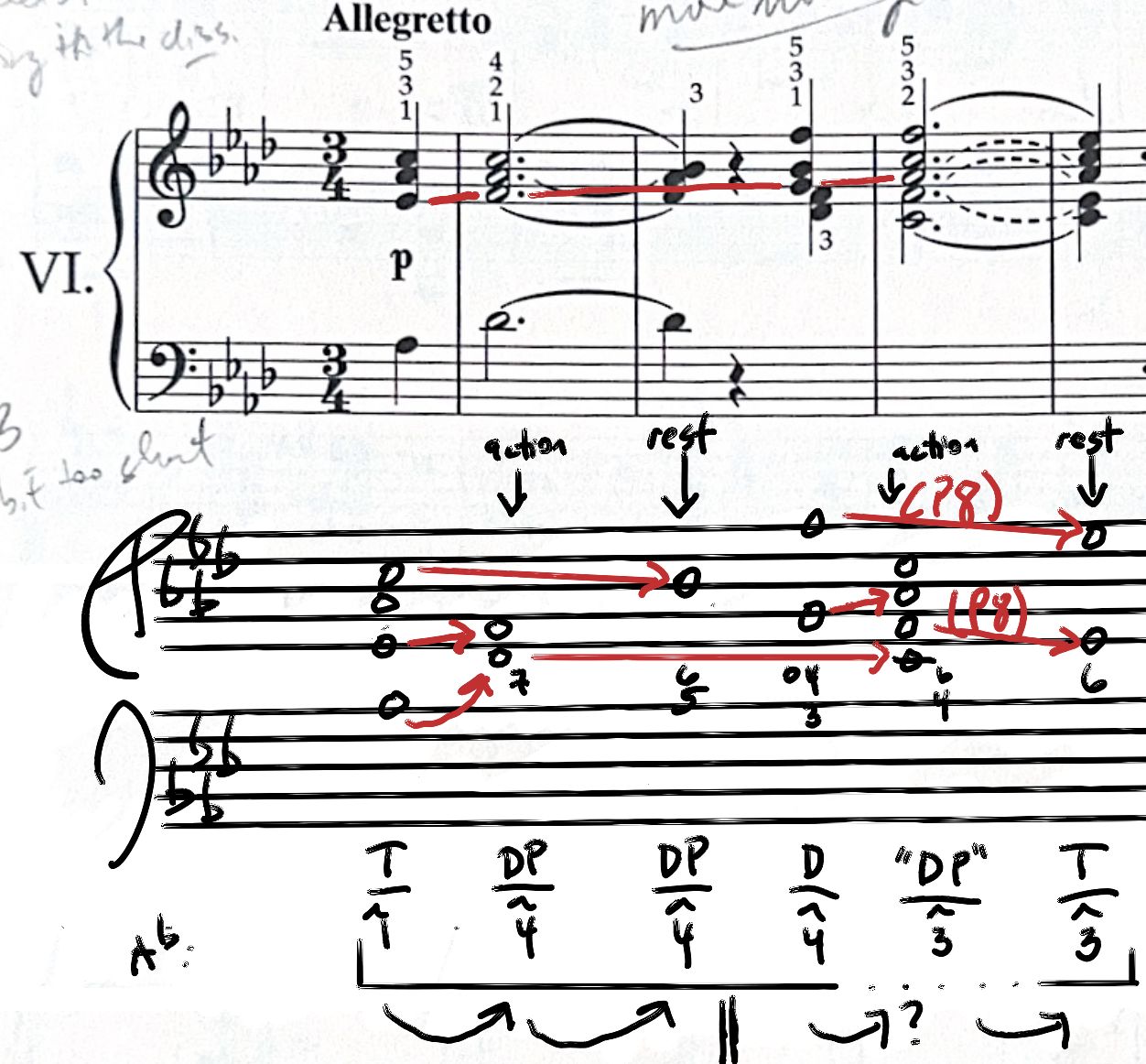
Alright: the top system is the score, and I’ve added some handwritten staves underneath. What I’ve done on the bottom system is to remove a lot of the repetition—along with the rhythmic notation—so that we can focus on the notes. I promise this reveals something about the rhythm!
Here’s the long and short: the “dissonant” moments found on the dotted half notes (measure 1 and 3) sound as though they are functionally equivalent. In other words, that they are doing the same sort of work acting as an “active,” or action-oriented bridge between a place of rest (pickup to measure 1 and 3) to another place of rest (first beat in measure 2 and 4). But “functionally” is the wrong word here, or maybe it’s the right one for the wrong reasons. Something odd is going on in the second dissonant moment: the pickup to measure 3 is using dominant harmony (built on G, scale degree 7, but appearing in second inversion). What follows is a dominant-prep harmony built on scale degree 6 in second inversion, leading back to tonic. This is unlike the first moment where both the action and the subsequent rest are part of the same functional category (measure 1 and first beat of measure 2).
The reason I say functional is the right word for the wrong reason is because it (measure 3) is the same as functional category before (DP) yet it shouldn’t—if we’re thinking of typical functional progressions—be here. Where the first moment confidently solidifies DP harmony (Tonic > Dominant Prep > Dominant Prep), the second moment throws D harmony into question as it slips back to DP (Dominant > Dominant Prep > Tonic—a nonfunctional ordering of progressions).
—
Okay, first: this is an extremely pedantic take. Most likely, we can choose to hear the second moment as “slipping” to DP function as a mere contrapuntal decision. What this means is that it may not have a function at all, rather what we see on the score is the simultaneity of pitches that happens to create DP harmony but ultimately is a means to draw the contrapuntal line back to tonic. The slippage I’m discussing is a side effect and, in tech parlance, a “feature rather than a bug.”
Second: there is something here, though. First pass: confident. Second pass: not so confident, throwing things into question. This is something we can work with, and something we can observe the piece with. What does it mean to think of this piece as a reflection of confidence and immediately throwing that confidence in doubt?
Third: should we consider that Schubert is moving in a retrograde (~backward) pattern? First moment: Tonic > Dominant Prep > Dominant Prep. Second moment: Dominant > Dominant Prep > Tonic. Which, putting it all together is a forward and backward run of your typical western harmony: tonic > dominant prep > dominant < dominant prep < tonic. What does it mean, if anything, that dominant function is at the center here? Or should we just “not consider” the second moment’s DP (built on scale degree 6) because it’s a contrapuntal chord? That would certainly simply our progression. It would also completely change our perception of the tension we feel here.